<?xml version="1.0" encoding="utf-8"?><feed xmlns="http://www.w3.org/2005/Atom" xml:lang="en"><generator uri="https://jekyllrb.com/" version="4.4.1">Jekyll</generator><link href="https://paulbuckley.me/feed.xml" rel="self" type="application/atom+xml" /><link href="https://paulbuckley.me/" rel="alternate" type="text/html" hreflang="en" /><updated>2026-09-07T19:17:21-07:00</updated><id>https://paulbuckley.me/feed.xml</id><title type="html">Paul Buckley’s Site</title><subtitle>Paul Buckley&apos;s personal website</subtitle><author><name>Paul Buckley</name></author><entry><title type="html">First Find Failure</title><link href="https://paulbuckley.me/2026/01/07/identify-failure.html" rel="alternate" type="text/html" title="First Find Failure" /><published>2026-01-07T01:00:00-08:00</published><updated>2026-01-07T01:00:00-08:00</updated><id>https://paulbuckley.me/2026/01/07/identify-failure</id><content type="html" xml:base="https://paulbuckley.me/2026/01/07/identify-failure.html"><![CDATA[<h1 id="first-find-failure">First, Find Failure</h1>

<p>Two weeks ago, I started running again after an extended hiatus. The last time I went for a run I also had not run in a long time and decided it was a great idea to do a 1h05m run.</p>

<p>To the surprise of no one, I fucked up my foot and had to wear around a foot cast for a few weeks with months of discomfort.</p>

<p>This isn’t the first time I’ve done something like this, so this time around I’m starting slow with some 20m runs and taking it real easy. But this has got me thinking:</p>

<p><strong>What most often knocks me out of a habit is hitting a failure point, not losing motivation.</strong></p>

<p>Every time I’ve fallen out of the habit of lifting weights, it wasn’t because I just stopped or got bored, but because I lost all momentum due to an injury or going on a long vacation. When I’ve started playing guitar again and the string breaks and it’s a pain to restring <em>(1)</em>, I’ve just stopped.</p>

<p>So now I’m starting to think deeper when starting anew:</p>

<p><strong>What would cause me to stop doing this? How could I mitigate that, prevent it from happening, or prepare beforehand?</strong></p>

<p>It’s easy to just think purely optimistically when starting something new that all you need is the positive optimism to keep going. And this is what most of the literature I’ve read around habits focuses on - but the hardest part of new habits for me is keeping them over a long period and not the initial activation energy.</p>

<p><em>(1) One time when restringing a guitar in high school it snapped and went through my finger… I may have some guitar-string-changing PTSD…</em></p>]]></content><author><name>Paul Buckley</name></author><summary type="html"><![CDATA[First, Find Failure]]></summary></entry><entry><title type="html">2026 OKRS</title><link href="https://paulbuckley.me/2026/01/03/okrs.html" rel="alternate" type="text/html" title="2026 OKRS" /><published>2026-01-03T01:00:00-08:00</published><updated>2026-01-03T01:00:00-08:00</updated><id>https://paulbuckley.me/2026/01/03/okrs</id><content type="html" xml:base="https://paulbuckley.me/2026/01/03/okrs.html"><![CDATA[<h1 id="2026-okrs">2026 OKRs</h1>

<p>Following onto my OKRs from… <a href="/2021/01/02/okrs.html">5 years ago</a>… I thought I’d try the exercise again. First I will start with a review of last year.</p>

<h2 id="2025-review">2025 Review</h2>

<p>2025 was a year where my thinking of it was primarily driven by outside factors. My dad died. My kids were young and… a lot of work. I was laid off. These are the big things I think of through the year, but weren’t particularly actionable “I did this well/poorly” things. So how did the year go?</p>

<h3 id="what-went-well">What went well?</h3>

<ul>
  <li>I kept to my goal of lifting weekly (175 total gym sessions) and progressed a bit there.</li>
  <li>I didn’t spiral when my dad passed - it was hard as hell and it still is, but I’m still living a good life.</li>
  <li>Maybe just correlating with getting a new job that I enjoy more, but I’m finding myself more focused and haven’t been spending as much mindless time on my phone doom-scrolling. Mentally I feel pretty clear.</li>
  <li>I really enjoyed taking the summer off with the family. I loved the time I spend with the kids.</li>
  <li>I finally started work at a startup which is something I’ve wanted to do for a long time.</li>
  <li>I made some new friends and spent more time than last year trying to cultivate relationships.</li>
</ul>

<h3 id="what-went-poorly">What went poorly?</h3>

<ul>
  <li>I’m still not where I want to be health wise - I’m 20-40lbs over where I feel most comfortable and my cardio is garbage.</li>
  <li>I’m still struggling to fit everything in. Being effective and efficient with my time is something I need to work on still.</li>
  <li>The “relationships” candle is still burning low in my life. While I have a couple good online chats with friends, I could improve with my in-person friendships (and extending this beyond just having our kids hang). Also, Stephanie and I could focus a bit more on US this year beyond just us being parents. Lastly, family has taken a more utilitarian bent without us focusing as much on the emotional needs of each other.</li>
  <li>While I’m at a startup like I wanted, I still don’t have a great direction for myself.</li>
  <li>We’re not making many memories. We’re still somewhat in the “survival” state of parenting it feels like and I’m hopeful in the coming year with the girls stopping naps, talking, and just growing up more we will begin to emerge and do fun things again.</li>
  <li>We spend so much fucking money on groceries and I don’t even understand how.</li>
</ul>

<h2 id="objectives-and-key-results">Objectives and Key Results</h2>

<p>Below are some high-level objectives for the year and some key results that help indicate movement towards the goals. Typically in tech parlance, Objectives are “a significant, concrete, clearly defined goal”, but life isn’t like a shippable product or feature so I’ll be a bit loose with that definition.</p>

<h3 id="objective-continually-improve-health">[Objective] Continually improve health</h3>

<p>Last year, I did well continuing my lifting streak with 175 works and lifting every week (currently at over 3 years of at least weekly lifting!). I didn’t gain any more weight, but I am still heavier than my ideal weight hovering around 220lbs. My main key result for the year will be losing weight, with the mechanism of doing so being to increase activity, improve food choices through meal prep, and reducing alcohol consumption.</p>

<ul>
  <li>[KR] Lifting 1x/week</li>
  <li>[KR] Run 1x/week</li>
  <li>[KR] 8k steps/day average</li>
  <li>[KR] &lt;= 2 drinks/week</li>
  <li>[KR] Weight reduced 220lbs –&gt; 200lbs</li>
</ul>

<p>Some things here like “do meal prep” I don’t particularly want to list as KR. Additionally, these are my low-end bars and if I do better, great!</p>

<h3 id="objective-establish-a-new-career-path">[Objective] Establish a new career path</h3>

<p>This year I hit my FI number despite being laid off. With this, my immediate salary and bumps to that aren’t really what needs to drive me and instead I seek to find out what I want from a career going forward. I considered for a period just stepping out of the game, but I do mostly enjoy work and still thinking being very early on at a startup some day would be interesting.</p>

<ul>
  <li>[KR] Write out a broad vision for my career future with some hypothetical milestones along the way.</li>
  <li>[KR] Get a mentor.</li>
  <li>[KR] Read 3 books on the topic.</li>
</ul>

<h3 id="objective-live-a-more-memorable-life">[Objective] Live a more memorable life</h3>

<p>The years keep coming and they don’t stop coming. I think my highest goal is to be able to look back on my life and think I lived it well, and a big part of that is doing more memorable things.</p>

<ul>
  <li>[KR] Continue to reduce screen time in order to effectively use time.</li>
  <li>[KR] Do 4 significant trips with the family throughout the year (this will hopefully increase in the future).</li>
  <li>[KR] Do something memorable monthly.</li>
  <li>[KR] Blog weekly</li>
</ul>

<p>It’s so easy to be tired or lazy. This is an objective to realize that time is finite and make the most of it.</p>

<h3 id="objective-cultivate-deep-relationships">[Objective] Cultivate deep relationships</h3>

<p>One thing I’ve discovered being a new parent is the ease of creating shallow friendships and the challenge of deeper ones. It’s easy for me to pick up a conversation with another parent at the park or arrange play dates where the focus is the kids, but getting deeper than that and developing real relationships takes work. Also with kids, where a couple-focused relationship was easy, it now takes work to take the time to <em>be</em> a couple.</p>

<ul>
  <li>[KR] Some periodic friend-only activity established.</li>
  <li>[KR] Bi-weekly date nights.</li>
  <li>[KR] Time spent with family outside just childcare time.</li>
  <li>[KR] At least 1 trip with non-local friends.</li>
  <li>[KR] Host bi-weekly pizza nights</li>
</ul>

<h2 id="conventional-new-years-resolutions">Conventional “New Year’s Resolutions”</h2>

<p>Just for fun I’m going to pop out some resolutions, mostly so I can look back and grade myself on this hodge-podge next year.</p>

<ul>
  <li>Run Bloomsday
    <ul>
      <li>Stretch: Break 1h05m</li>
    </ul>
  </li>
  <li>Run 3x 5K races
    <ul>
      <li>Stretch: Break 22m</li>
    </ul>
  </li>
  <li>Compete in a powerlifting meet
    <ul>
      <li>Stretch: Break 1000 lbs</li>
    </ul>
  </li>
  <li>Get a promotion, bump in equity/comp, or some other external validation</li>
  <li>Do 3 flights (or longer drives, not Seattle) with the kids</li>
  <li>Get below 15% bodyfat</li>
  <li>Go overnight camping with at least one of the kids</li>
</ul>

<h2 id="what-could-throw-things-off-my-goals">What could throw things off my goals?</h2>

<ul>
  <li><strong>Health issues or injuries</strong>: I need to make sure I listen to my body.</li>
  <li><strong>Family health issues</strong>: Not much I can do here.</li>
  <li><strong>Spending too much time at work</strong>: For the life I want to live, I need balance and I need to make sure I don’t go too far down this path.</li>
  <li><strong>Checking out from work</strong>: If I’m not enjoying what I’m doing such that I check out, this is a sign I need to adjust something.</li>
  <li><strong>I get lazy and don’t do things</strong>: Work, family, and fitness take a lot of energy and it can be hard to actually prioritize doing things that stretch you.</li>
  <li><strong>Not prioritizing things that need planning</strong>: I do not like planning social things, but to cultivate relationships you need this.</li>
</ul>]]></content><author><name>Paul Buckley</name></author><summary type="html"><![CDATA[2026 OKRs]]></summary></entry><entry><title type="html">TALK EARLY</title><link href="https://paulbuckley.me/2025/09/17/talk-early.html" rel="alternate" type="text/html" title="TALK EARLY" /><published>2025-09-17T02:00:00-07:00</published><updated>2025-09-17T02:00:00-07:00</updated><id>https://paulbuckley.me/2025/09/17/talk-early</id><content type="html" xml:base="https://paulbuckley.me/2025/09/17/talk-early.html"><![CDATA[<h1 id="talk-early">TALK EARLY</h1>

<p>This is my first week at a new job and during my first all hands meeting, I (unprompted) brought up a story about how I threw up on a livestream in front of a bunch of people.</p>

<p><em>Why would I do this?</em></p>

<p>One principle I have in life is that you adhere to whatever mold you have of yourself. If you view yourself as someone who works out, you do that. If you view yourself as someone who isn’t afraid to talk and bring up your opinion, you do that. But that belief first comes from doing - you can’t view yourself as someone who works out without actually working out, and the same goes for talking.</p>

<p>The problem with being in a new group of people is that initially you don’t have much to say. Being at a new company, I can’t bring up insightful insights in an initial all hands or present some slide. I need to find a way to talk early so I can start building the image of myself as someone who speaks up. So what better way than some comedic anecdote?</p>

<p>It’s easy to not speak up early. To believe you have nothing to say or insights when you don’t really know what’s going on (which… I don’t still after day 3 there). It’s when that habit builds and silence solidifies that you have a problem. That is why I always try and find a way to break the ice early so I view myself as someone who speaks up.</p>]]></content><author><name>Paul Buckley</name></author><summary type="html"><![CDATA[TALK EARLY]]></summary></entry><entry><title type="html">MO(RE)MENTUM</title><link href="https://paulbuckley.me/2025/09/03/morementum.html" rel="alternate" type="text/html" title="MO(RE)MENTUM" /><published>2025-09-03T02:00:00-07:00</published><updated>2025-09-03T02:00:00-07:00</updated><id>https://paulbuckley.me/2025/09/03/morementum</id><content type="html" xml:base="https://paulbuckley.me/2025/09/03/morementum.html"><![CDATA[<h1 id="morementum">MO(RE)MENTUM</h1>

<p>Habits have never made much sense to me. At least in the way they’ve been talked about in books like Atomic Habits, where they are more complex tasks that involve conscious effort to accomplish like going to the gym or eating healthy. To me, habits are things like putting my right leg in my pants before my left or washing my hands after going to the bathroom. Cultivating these actions I want in life takes conscious effort no matter how ingrained they are.</p>

<p>The mental model I prefer for these sorts of activities is <strong>momentum</strong>.</p>

<p>Momentum has two key aspects:</p>

<ol>
  <li>Gaining momentum takes more effort than maintaining momentum.</li>
  <li>Maintaining momentum involves matching drag/friction with effort and avoiding collisions.</li>
</ol>

<p>This concept helps me frame actions that I want to take.</p>

<h2 id="gaining-momentum">GAINING MOMENTUM</h2>

<p>What are some real life examples of things that take extra effort to gain momentum on?</p>
<ul>
  <li>Starting to floss has the initial momentum hurdle of bleeding gums, but once you get over that it’s less painful to maintain.</li>
  <li>Starting lifting weights results in extra soreness that decreases as you lift more as well as the education hurdle of knowing what to do.</li>
  <li>Eating healthy and reducing sugar intake has the hurdle of initial sugar cravings.</li>
  <li>Moving to an ergonomic keyboard has a hurdle of figuring out where the fuck your fingers go.</li>
</ul>

<p>These are all things that take a bit of extra effort to start, but take less effort once moving. <strong>Acknowledging that the initial effort is greater than what it will take to maintain has been helpful for me in getting over those initial hurdles, as has identifying what the initial challenge will be and preparing for it.</strong></p>

<h2 id="maintaining-momentum">MAINTAINING MOMENTUM</h2>
<p>The second aspect of momentum that I resonate with for activities is identifying desired momentum I want and calculating the effort needed to overcome the drag and plan for obstacles. Here are some examples:</p>

<ul>
  <li>For flossing, I’d like to maintain a daily flossing routine so I ensure I always have floss next to the sink I use during wind down. I shouldn’t have to search for it.</li>
  <li>My home gym makes the effort of getting to the gym very low, and making my only consistent goal for lifting to be to go at least once a week to at least maintain gains sets the bar low and easy to maintain and not dissuade myself when life gets in the way. I typically end up going much more than this but that just the cherry on top!</li>
  <li>For eating healthy, buying only healthy groceries at the store makes eating healthy relatively trivial (same goes for abstaining from purchasing alcohol)</li>
</ul>

<p>For me, this framing is extremely helpful. All you’re trying to do is set a bar for how much momentum is acceptable for something then defining the effort and removing obstacles where possible!</p>]]></content><author><name>Paul Buckley</name></author><summary type="html"><![CDATA[MO(RE)MENTUM]]></summary></entry><entry><title type="html">STORIES YOU’RE TOLD</title><link href="https://paulbuckley.me/2025/06/27/stories.html" rel="alternate" type="text/html" title="STORIES YOU’RE TOLD" /><published>2025-06-27T02:00:00-07:00</published><updated>2025-06-27T02:00:00-07:00</updated><id>https://paulbuckley.me/2025/06/27/stories</id><content type="html" xml:base="https://paulbuckley.me/2025/06/27/stories.html"><![CDATA[<h1 id="stories-youre-told">STORIES YOU’RE TOLD</h1>

<p>The other day I drove by a house where a dad and his adult handicapped son were sitting. I reflexively thought to myself “Wow, that dad is a saint” - but then caught myself… Is he a saint? Why do I just assume that that dad is a good person? I don’t really have much data on their character so it led me to ponder why that was the narrative that immediately came to mind.</p>

<p>The conclusion I came to was that this is a story my dad would often tell. He’d talk glowingly about parents with handicapped children and how those parents should be “given medals”. He got to saw first-hand how difficult it can be and chose to voice that life view when we were around.</p>

<p>This is an important parenting lesson for me. It isn’t as if he specifically taught us to view people in that way, but threw off-hand mentions through the years it built up this narrative in my head as well. The stories we tell in front of our kids become the stories they believe regardless of if we’re intending to.</p>

<p>The successful person down the block, are they lucky or are they a hard worker? That homeless person, are they lazy or are they beaten down by the world? That fall off the bike, was it scary or brave? The way we create stories as parents is important and can shape kids in ways we don’t intend.</p>]]></content><author><name>Paul Buckley</name></author><summary type="html"><![CDATA[STORIES YOU’RE TOLD]]></summary></entry><entry><title type="html">I WAS LAID OFF</title><link href="https://paulbuckley.me/2025/02/19/laid-off.html" rel="alternate" type="text/html" title="I WAS LAID OFF" /><published>2025-02-19T01:00:00-08:00</published><updated>2025-02-19T01:00:00-08:00</updated><id>https://paulbuckley.me/2025/02/19/laid-off</id><content type="html" xml:base="https://paulbuckley.me/2025/02/19/laid-off.html"><![CDATA[<h1 id="i-was-laid-off">I WAS LAID OFF</h1>

<p>Unlike some other people at Meta, I was definitely having performance issues prior to the layoffs. I received a Meets Some rating (basically the lowest rating) for my last year here, and while I think that is a bit harsh, it has gotten me thinking about what the fuck happened and the broader context of the layoffs.</p>

<h2 id="background">BACKGROUND</h2>
<p>I worked at Meta for 10.5 years, and in the 16 official review cycles before this one I had received:</p>
<ul>
  <li>12x Exceeded Expectations ratings</li>
  <li>2x Greatly Exceeded Expectations ratings</li>
  <li>2x Meets All expectations (1x when on parental leave for the half, the other when transitioning from manager to individual contributor)</li>
</ul>

<p>In addition, I was promoted from E3 (noob) to E6 (level above senior engineer).</p>

<p>I say this not to brag but to maybe put light on the fact that it wasn’t “bottom 5%” of engineers that were laid off - at least I don’t feel like my past performance indicates I’m a bottom 5% engineer.</p>

<p>For a lot of us, this could have been a short negative blip in a long career where the focus was on family or mental health or we delt with temporary work conflicts. We’ll never know though as Meta wanted to cut and cut it did. I won’t pretend to know what would have been a better move, but this certainly doesn’t feel optimal.</p>

<p>So with that out of the way and with some introspection over the last week, <strong>what led to my shit performance last year?</strong></p>

<h2 id="depression">DEPRESSION</h2>

<p>First, depression. Our second daughter has had a lot of sleep issues, and it turns out that chronic lack of sleep can break your mind (this video hit me hard). Kids are fucking hard.</p>

<p>My dad was also diagnosed with terminal cancer last spring which I’ve been struggling to come to terms with (we are very close) and which has led to a lot of existential thoughts.</p>

<p>Coupled with two kids under 3 years old who were perpetually sick for the last 6 months, this didn’t leave me much time to focus on myself and making sure my head was above water - in hindsight I should have taken some time off while we had childcare (time which I’m getting now and it feels great!).</p>

<h2 id="misalignment-with-management">MISALIGNMENT WITH MANAGEMENT</h2>

<p>I want to emphasize that a lot of this was exacerbated by my depression making it difficult to cope with conflict. What follows is a take on my feelings and a heavy dose of copium. My feelings started shifting around the time of feeling depressed, so whether causal or coincidental is up for interpretation.</p>

<p>First in terms of me/management misalignment, there was the issue of what to work on - I can’t get into details, but we did not agree on what work was valuable to work on. In hindsight, I should have just gone with what I thought was important and interesting instead of… just not really doing anything (well not anything, but focusing on more reactive work). I should have given this feedback at the time that I needed to have something else to work on or committed to sticking to what I thought was important.</p>

<p>Second for misalignment, was on how I worked. I am not someone who should ever work on medical equipment or aircrafts - I came of engineering age at the time where Facebook was on the “Move Fast and Break Things” train and that is how I work best (*). There were a few instances where I moved fast and indeed did break things (which were easily fixable) and received harsh, repeated negative feedback. This, coupled with the apathy of depression, made me just not want to do anything. In hindsight, I should have seeked out a different situation where my creativity and move-fast mentality (and associated lack of attention to detail) would be an asset.</p>

<p>(*) I hate labels, but I listened to a podcast on ADHD and the tech industry and I’ve never listened to something where I felt like “woah that’s me!” as much as that was.</p>

<h2 id="lacking-scope">LACKING SCOPE</h2>

<p>When I went out on parental leave, I had to give all of my scope away - scope which was difficult to pick up the first time I went on parental leave after only being back about a year. As an E6 engineer you are expected to create your own scope which is challenging when 1) your company isn’t clear on what it is working on (my main project was de- and re-prioritized multiple times) and 2) there are cancelations of programs making your team top-heavy.</p>

<p>In hindsight, I would have still taken my parental leave as that is my #1 priority (and I didn’t get more than 3 hours of consecutive sleep for 6 months anyways) but would have just committed fully to the project which was always in limbo - I could have stepped up and moved up the stack to gain scope.</p>

<h2 id="burn-out">BURN OUT</h2>

<p>I do not care about VR/MR. I actively dislike video games and that is still the primary use case of it (despite hopes).</p>

<p>In the beginning of working on Oculus, it was extremely exciting - we were the darling of the tech community and I rode that wave of excitement for years. “Oh wow you work at Oculus?! That’s so cool I wish I could work on that!” was a common refrain. While one shouldn’t be externally motivated by the feelings of others, there was an excitement of working there - we were making on the next big thing!</p>

<p>Over the years though, the excitement waned. We fell into a niche market working on the next incremental thing. Instead of focusing on external excitement, I started focusing more on myself and my career growth. This re-lit the excitement candle for me for a period - I lusted after getting that next title and the salary that came with it… until I didn’t.</p>

<p>My dad getting sick started shifting my perspective. We only have so much time on this earth and we can choose how we spend it. My kids will only be this age young once. My dad will be dead this year. My mom won’t always be around. I won’t always be around.</p>

<p>Why did I need the promotion? Why did I need to work on something I didn’t care about? Is this how I want to spend my time? I read about the idea of “<a href="https://www.forbes.com/sites/traversmark/2024/03/03/a-psychologist-explains-misalignment-burnout-when-your-job-isnt-your-purpose/">misalignment burn out</a>”, which feels pretty accurate for me. My only real alignment towards my values was that I was learning things from super fucking smart people and that I loved my coworkers after working with many of them for many years.</p>

<h2 id="what-now">WHAT NOW?</h2>

<p>In one-week hindsight, I’m super happy that I was let go. This is an amazing opportunity for me for a few reasons:</p>

<ul>
  <li>There are tons of things I want to work on (I’ll write up something on what excites me later)</li>
  <li>I will be getting paid to spend time with my family</li>
  <li>I needed a break after working on more or less the same thing for 10.5 years</li>
</ul>

<p>And I’ll be totally fine. As I joke with everyone, this leaves me time to get totally jacked and start an OnlyFans page. Hopefully it doesn’t come to that, but I will have lots of time to get in the best shape of my life without excuses :)</p>]]></content><author><name>Paul Buckley</name></author><summary type="html"><![CDATA[I WAS LAID OFF]]></summary></entry><entry><title type="html">2021 OKRS</title><link href="https://paulbuckley.me/2021/01/02/okrs.html" rel="alternate" type="text/html" title="2021 OKRS" /><published>2021-01-02T01:00:00-08:00</published><updated>2021-01-02T01:00:00-08:00</updated><id>https://paulbuckley.me/2021/01/02/okrs</id><content type="html" xml:base="https://paulbuckley.me/2021/01/02/okrs.html"><![CDATA[<h1 id="2021-objectives-and-key-results">2021 OBJECTIVES AND KEY RESULTS</h1>

<p>Stephanie and I had a conversation yesterday about what would make 2021 a “good” year for ourselves, and I got to thinking that maybe this could be an interesting time to apply the <a href="https://en.wikipedia.org/wiki/Objectives_and_key_results">Objectives and Key Results (OKRs)</a> framework we use at work to my personal life. Because I’m a geek like that. So what would mine be for 2021? (Bear with me as I totally ignore the shit storm of 2020 and the continued fallout into 2021 from it.)</p>

<p>But first, what are OKRs?</p>

<p>I like how they are described at <a href="https://www.perdoo.com/resources/online-guides/okr-guide">perdoo</a>:</p>

<blockquote>
  <p>An OKR consists of an Objective, which tells you where to go, and several Key Results, which are the results you need to achieve to get to your Objective. Initiatives are all the projects and tasks that will help you achieve your Key Results.</p>
</blockquote>

<p>To me, they are better than New Years Resolutions in that they define the why for what you wish to achieve and are intended to NOT be all or nothing. Below I’ll list out some high-level Objectives (the “where I’m wanting to go”) with some Key Results follow (how do I measure that I’m getting there?) for the year.</p>

<p>So, what are mine for the coming year? (Note that some are really more long-term than the next year, but fuck you don’t be pedantic).</p>

<h2 id="objective-live-a-long-and-healthy-life">OBJECTIVE: LIVE A LONG AND HEALTHY LIFE</h2>
<p>I like the idea of being able to go on hikes with my grandkids and live to maybe see my great-grandkids and not be sitting in a charge for 24 hours a day as I hit 80. This does have some differences from just “being healthy” - I don’t aspire to run a 5 minute mile again or deadlift 500 lbs, I want to be able to walk when I’m 95 and play catch when I’m 75 while being mentally present.</p>
<ul>
  <li>KR: One day or less of drinking/week (measure x/52 weeks)</li>
  <li>KR: Home cooked meals daily (measure x/365 days)</li>
  <li>KR: Some form of regular cardio (measure x/365 days)</li>
  <li>KR: Lift weights 3 days/week (measure x/52 weeks)</li>
  <li>KR: Sleep 7.5 hours/night (measure x/365 days)</li>
  <li>KR: Do a daily fast once per month (measure x/12 months)</li>
  <li>KR: Reach a healthier long-term weight of 170lbs (measure from 185lbs)</li>
</ul>

<h2 id="objective-be-a-good-family-man">OBJECTIVE: BE A GOOD FAMILY MAN</h2>
<p>We plan on having kids this year, and I want to make sure I’m doing my part for our household, being a good husband, and preparing for our first child.</p>

<ul>
  <li>KR: Complete work making house more livable (basement remodel, yard, finishing)</li>
  <li>KR: Actively participate in child prep (books, appointments) and care</li>
  <li>KR: Spend time 5 days a week training the dog (measure x/52 weeks)</li>
  <li>KR: Improve communication with Stephanie through regularly touch-in conversations</li>
</ul>

<h2 id="objective-develop-a-deep-life">OBJECTIVE: DEVELOP A “DEEP LIFE”</h2>

<p>I’m a fan of Cal Newport’s “Deep Work” philosophy, and also enjoy the extension of this to every day life to create a “Deep Life” (also this) - one filled with spending intentional time on things that are worth spending time on. The biggest item here is getting my life mind back in a practice where I can focus again, after spending the last 10 months giving myself leeway due to COVID and having fully scattered days as a manager at work.</p>

<ul>
  <li>KR: Meditate daily (measure x/365 days)</li>
  <li>KR: Journal week-daily (measure x/261 days)</li>
  <li>KR: Less than 30 minutes of mindless screen time daily (measure x/365)</li>
  <li>KR: Establish and develop three creative hobbies through daily time spent (measure x/365 +/- travel times)</li>
  <li>KR: Switch to an IC role where I can develop my craft of programming</li>
</ul>

<h2 id="objective-become-financially-independent">OBJECTIVE: BECOME FINANCIALLY INDEPENDENT</h2>
<p>This Objective is a bit more of the “what” than the “why” than I wish to put here, but given the benefits of becoming financially independent (freedom in what you work on, given that I still want to work after becoming “FI”) I did want to put some distinct results KR’s around finances. We’re already starting the year in a pretty good place, so these mostly focus on reducing some spending so we can get to a place where we no longer need to work faster.</p>

<ul>
  <li>KR: Reduced recurring/daily life spending to under $2000/month (not counting housing expenses and travel)</li>
  <li>KR: Do monthly budget check-ins</li>
  <li>KR: Develop a concrete number where we consider ourselves to be financially independent</li>
  <li>KR: Reduce food waste significantly (we waste a fair amount of money on wasted food)</li>
</ul>

<h2 id="closing-thoughts">CLOSING THOUGHTS</h2>
<p>For the most part, these are pretty self-centered and privileged OKR’s, and I acknowledge that. I considered putting in some around family and friends, but decided against that as it isn’t something I particularly want to track and charity is similar.</p>

<p>I’ll likely follow up in another post on how I’m tracking these, so this idea isn’t over!</p>]]></content><author><name>Paul Buckley</name></author><summary type="html"><![CDATA[2021 OBJECTIVES AND KEY RESULTS]]></summary></entry><entry><title type="html">SIMPLE VS EASY</title><link href="https://paulbuckley.me/2020/04/02/simple-vs-easy.html" rel="alternate" type="text/html" title="SIMPLE VS EASY" /><published>2020-04-02T02:00:00-07:00</published><updated>2020-04-02T02:00:00-07:00</updated><id>https://paulbuckley.me/2020/04/02/simple-vs-easy</id><content type="html" xml:base="https://paulbuckley.me/2020/04/02/simple-vs-easy.html"><![CDATA[<h1 id="simple-vs-easy">SIMPLE VS EASY</h1>

<p>It’s a conversation I’ve had now a few times:</p>

<blockquote>
  <p>What do I need to do to get a promotion?</p>
</blockquote>

<p>While I won’t go into details of answers, it has brought up the comparison of Simple vs Easy, which on the surface sound interchangeable but mask different concepts.</p>

<p>Easy things don’t take much effort. Simple things don’t require much thought.</p>

<ul>
  <li>Navigating a car is easy, but not simple (at least when you’re first learning).</li>
  <li>Lifting a 500 pound weight isn’t easy, but it is simple.</li>
  <li>Getting promoted to a senior engineer is simple, but not easy.</li>
</ul>

<p>Let me clarify the last bullet point there. To get promoted from a junior engineer, you need to show 1) technical proficiency and 2) an ability to deliver on a project of increasing scope. It’s that simple. On the flip side, gaining technical proficiency by doing months and years of work is not easy, nor is leading a project.</p>

<p>But the path is simple.</p>

<h2 id="why-is-this-important">WHY IS THIS IMPORTANT?</h2>
<p>Most things in life are pretty simple when you have a clear understanding of the playing field. If you don’t think something is simple, it might be worth taking a look at your assumptions and to learn more about what you’re trying to accomplish. Test those assumptions.</p>

<p>Once a simple path has been determined, things might be hard, and it’s important to differentiate the two to ensure you’re working on the right things.</p>]]></content><author><name>Paul Buckley</name></author><summary type="html"><![CDATA[SIMPLE VS EASY]]></summary></entry><entry><title type="html">EXPERIMENT - TIME TRACKING</title><link href="https://paulbuckley.me/2019/07/07/time-tracking.html" rel="alternate" type="text/html" title="EXPERIMENT - TIME TRACKING" /><published>2019-07-07T02:00:00-07:00</published><updated>2019-07-07T02:00:00-07:00</updated><id>https://paulbuckley.me/2019/07/07/time-tracking</id><content type="html" xml:base="https://paulbuckley.me/2019/07/07/time-tracking.html"><![CDATA[<p><em>Unfortunately, when deleting my old website I lost the images for this post so a lot of context is missing. Below is just the text from my original post</em></p>

<hr />

<h1 id="experiment-time-tracking">[EXPERIMENT] TIME TRACKING</h1>

<p>Over the last few months I’ve been catching up with the Cortex podcast which focuses on productivity in the digital age amongst other things.  One of the hosts often talks about time tracking and its benefits.</p>

<p>So I thought I’d try it out for a week.</p>

<h2 id="what-i-wanted-out-of-time-tracking">WHAT I WANTED OUT OF TIME TRACKING</h2>

<p>Before starting, I decided I wanted two things to come out of the experiment:</p>

<ol>
  <li>See where my time was going</li>
  <li>Be more mindful of how I spend my time</li>
</ol>

<p>The first item was the result of me coming home from work one too many times thinking to myself “what the hell did I do with my time today?”</p>

<p>The second item was more general and something I’ve thought about over the years - making an effort to spend time “consciously” rather than “unconsciously”.  It can be all too easy to lose yourself in mindless tasks like browsing Reddit where you can’t put a finger on exactly how long you’d been doing the thing, but don’t feel that you’ve gotten anything out of it.</p>

<h2 id="methodology">METHODOLOGY</h2>

<p>The system I decided to use wasn’t the result of much research.  I started with the base of using Toggl, which allows you to start and stop timers connected to “projects” so you can see how much time you spent on each (I used the desktop and iPhone app versions).  I defined a set of projects for myself which weren’t all actual projects.  These boiled down to:</p>

<ul>
  <li><strong>Commute</strong> - getting to and from work</li>
  <li><strong>Socializing</strong> - chatting with people in the office not about work</li>
  <li><strong>Communication</strong> - general tasks like reading/writing emails, catching up on message threads, etc.</li>
  <li><strong>Tomfoolery</strong> - looking at random tech sites on my computer, playing with my phone, etc.</li>
  <li><strong>Bodily Functions</strong> - bathroom breaks and eating/snacking</li>
  <li><strong>Exercise</strong> - I go to the gym every day before lunch</li>
  <li><strong>Meta-Work</strong> - setting things up at my desk, cleaning my work area, planning out my day, etc.</li>
  <li><strong>Meetings</strong></li>
  <li><strong>Reviews/Teamwork</strong> - doing code reviews, reading design documents</li>
  <li><strong>Project work</strong> - this I broke down by actual work projects which I’m not going to name here. I had 4 separate work projects I worked on during the experiment</li>
</ul>

<p>Along with the activity breakdown, I set up a few rules for myself:</p>

<ol>
  <li><strong>Tracking hours</strong> - Track all time from getting in my car to go to work to entering my garage on my return home</li>
  <li><strong>Log everything</strong> - Every time I context switch, no matter how long, log the change. Even if I only switched for a few seconds.</li>
  <li><strong>Priority</strong> - If something qualified for more than one activity, log it for the more general one. For example, a meeting for Project A would be tracked in the Meetings activity, and time spent writing an email for Project B would be tracked in the Communication category.</li>
</ol>

<p>With these rules set up on Sunday, I set out on Monday to track my time.</p>

<h2 id="execution">EXECUTION</h2>

<p>Luckily for me, Toggl has an excellent desktop app that makes logging incredibly easy.  Literally the press of a single button to switch, so the overhead of logging each switch was low.  This ended up being important so that I would actually log each context switch.</p>

<p>This app, which I dedicated 1/3 of a mac OS Space to on my dual-monitor setup (or 1/6 when not connected to a monitor), along with the app made the process painless.</p>

<p>The only hitch on the execution phase was the awkward moment I’d spend deliberately pressing the Socializing button whenever someone came up to talk.</p>

<h2 id="results-and-learnings">RESULTS AND LEARNINGS</h2>

<p>I learned more than I thought I would during this experiment.  Some of this was meta-learned from thinking about tracking of time in general rather than directly from the tracking itself.</p>

<p>Below are my main take aways.</p>

<h3 id="i-get-distracted-a-ton">I GET DISTRACTED A TON</h3>

<p>All together, I had approximately 118 “interruptions” during the week that I recorded, and I believe I did not mark down many of them.</p>

<p>I broke down my distractions to five sources:</p>

<ol>
  <li><strong>Online, external</strong> - Notifications from emails, messages, tasks, etc.</li>
  <li><strong>In-person, external</strong> - People stopping by my desk</li>
  <li><strong>Internal</strong> - e.g. “I’m bored, I should check out Reddit!”</li>
  <li><strong>Obligations</strong> - Meetings</li>
  <li><strong>Bodily functions</strong> - You can figure this one out</li>
</ol>

<p>With these in mind I set about thinking about how I could decrease the frequency and length of each systemically:</p>

<ol>
  <li><strong>Online, external</strong> - Disable all notifications, instead setting a time when I’d check if any message came in (e.g. only check on the hour).  Almost all notifications can wait at least an hour.</li>
  <li><strong>In-person, external</strong> - This is the hardest of the bunch, and I could only come up with telling coworkers to bug me less (ineffective) or working from home.  Both can be difficult.</li>
  <li><strong>Internal</strong> - A long struggle of mine, battling the inner ADD, this is a subject for a whole other entry here.  This isn’t as easily systemized out.</li>
  <li><strong>Obligations</strong> - RSVP “Yes” to fewer meetings, only attend what is needed and feel free to leave if the meeting isn’t helpful.</li>
  <li><strong>Bodily functions</strong> - This one I let slide.  Sometimes you just have to go.  Sometimes you’re just hungry.</li>
</ol>

<p>Distractions are a topic I’ll likely write about more at a later time and could easily fill an entry in itself.  This is just scratching the surface.</p>

<h3 id="i-spend-more-relative-time-than-i-thought-working">I SPEND MORE (RELATIVE) TIME THAN I THOUGHT WORKING</h3>

<p>Removing all the non-project and necessary communication/meeting time, the relative time I spend actively working is more than I thought.</p>

<p>The general timing broke down as:</p>

<ul>
  <li>Total time: 42:40* (31:25 without commute + exercise + bodily functions)</li>
  <li>Project work: 20:43</li>
  <li>Non-project work: 6:57 (meetings + communication + meta-work + team work)</li>
  <li>“Wasted” time:  3:02 (socializing + tomfoolery)</li>
  <li>Life overhead: 11:15 (commute + exercise + bodily functions)</li>
</ul>

<p><em>(*) Admittedly this was a lighter work week than usual so the hours are low, but the ratios still apply.</em></p>

<p>If you take out the “life overhead”, the amount of work to wasted time actually looks favorable!</p>

<h3 id="i-rarely-work-in-large-unbroken-chunks-of-time">I RARELY WORK IN LARGE, UNBROKEN CHUNKS OF TIME</h3>

<p>This is mostly the result of distractions and is the end-goal of reducing distractions.  My ideal is to fill my day with as many uninterrupted chunks of time on single tasks so I don’t incur the mental overhead hits of context switching.</p>

<p>Here’s a graph showing how many of my entries were short, interrupted ones versus longer, uninterrupted ones:</p>

<h3 id="number-of-entries-with-given-durations">NUMBER OF ENTRIES WITH GIVEN DURATIONS</h3>

<p>As you can see, most of my entries are for short durations.</p>

<h3 id="my-hours-are-more-regular-than-i-thought">MY HOURS ARE MORE REGULAR THAN I THOUGHT</h3>

<p>While I maintain that I enjoy the privilege of setting my own hours, it turns out my enter and exit times for work are largely determined by traffic and dinner time.</p>

<h3 id="workday-start-and-end-times">WORKDAY START AND END TIMES</h3>
<ul>
  <li>Start Time</li>
  <li>End Time</li>
</ul>

<p>Time is in 24-hour format</p>

<p>This is the information that will likely change the most as I continue on tracking time, especially when summer comes around and I can bike to work.</p>

<h2 id="going-forward">GOING FORWARD</h2>

<p>I am going to continue tracking my time, but I am going to approach it a little differently to get a better return on investment.  Continuing the experiment will keep me honest with myself and keep me using the systems I’m putting in place to get distracted less.</p>

<p>There are a couple things I’m going to change though…</p>

<h3 id="time-tracking-logistics">TIME-TRACKING LOGISTICS</h3>

<p>The biggest logistical change I want to make is to stop tracking commute, exercise, and major meals as these don’t unintentionally break up my chunks of work as they are planned.</p>

<h3 id="mixing-up-location">MIXING UP LOCATION</h3>

<p>Last year I spent a very productive week working in Maui.  What made it productive?  No distractions, mainly.</p>

<p>With that previous experience in mind, I’m going to push for more time working out of the office, be that in a different location or at home, I can’t really increase my distractions from socializing much more than I have at work so it’s worth a try.</p>

<hr />

<p>There’s more to come!  I have a few more productivity “hacks” in mind that I’ll be writing about once I’ve ran through the experimentation phase, so stay posted.</p>]]></content><author><name>Paul Buckley</name></author><summary type="html"><![CDATA[Unfortunately, when deleting my old website I lost the images for this post so a lot of context is missing. Below is just the text from my original post]]></summary></entry><entry><title type="html">JUMPING INTO MANAGEMENT</title><link href="https://paulbuckley.me/2019/07/07/jumping-into-management.html" rel="alternate" type="text/html" title="JUMPING INTO MANAGEMENT" /><published>2019-07-07T02:00:00-07:00</published><updated>2019-07-07T02:00:00-07:00</updated><id>https://paulbuckley.me/2019/07/07/jumping-into-management</id><content type="html" xml:base="https://paulbuckley.me/2019/07/07/jumping-into-management.html"><![CDATA[<h1 id="jumping-into-management-lessons-learned-so-far-pt-1">JUMPING INTO MANAGEMENT: LESSONS LEARNED SO FAR (PT 1)</h1>

<p>About one human-baby-gestation-period ago, or 9 months in common parlance, I jumped into management. At first it started with a single human, then a few months later that escalated 400% to four (or a nibble of engineers, in non-common parlance), and now seven unfortunate souls have to sit with me in 1:1s every week.</p>

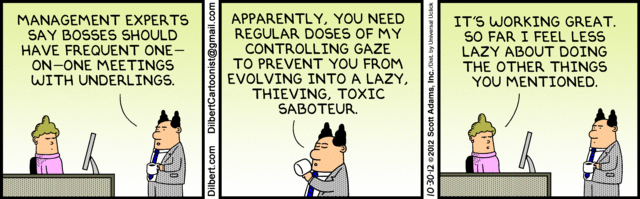
<p><img src="/assets/images/badmeetingsdilbert.png" alt="How I viewed 1:1s at some point" /></p>

<p>While my efficacy in the role is still up for consideration, and maybe something someone else should evaluate, I have learned a few things in this time.</p>

<h2 id="you-really-should-stopgreatly-reduce-time-spent-on-technical-work">YOU REALLY SHOULD STOP/GREATLY REDUCE TIME SPENT ON TECHNICAL WORK</h2>

<p>During most of my experience so far, I have spent significant percentages of my time doing technical work. This, more often than I count, resulted in me rolling into 1:1s saying dumb shit like:</p>

<blockquote>
  <p>“Well you know I’ve been heads down on this bug for the last week and haven’t given any thought to you followed up from our items last week”</p>
</blockquote>

<p>A great way to show care!</p>

<p>If possible, you really should make strides toward reducing time spent on non-manager tasks to give people the time they need. This lesson has been reflected in pretty much every piece of beginner-manager advice I’ve read, but it’s also one of those things that can very easily fall under the “oh after THIS one time I’ll start doing my real job!”.</p>

<h2 id="people-are-not-you">PEOPLE ARE NOT YOU</h2>

<p>After spending many, many hours in talks with people about their work, how they operate, and where they want to go, I’ve come to the conclusion that other people are not the same person as me.</p>

<p>This has come as a bit of a shock!</p>

<ul>
  <li>Where I may push back on every assumption or request on my time, others may not, and so working with them I’ve needed to keep that in mind when planning projects.</li>
  <li>Where I might hassle my manager every 1:1 about promotion or ratings leading up to PSCs, other people are less comfortable talking about this or are more passive about it, but still be stressed by the process and need to be talked to.</li>
  <li>Where I’ll want to know what I’ll be working on 13.5 weeks out, others are more flexible with their plans.</li>
</ul>

<p>Finding those differences and framing conversations with them in mind is a muscle that is difficult to flex. This is should be obvious, but I’d say most people do a very poor job at this and it can be hard to be self-reflective enough to identify your own hidden assumptions and beliefs. These assumptions and beliefs you have are a key part of your ability to manage humans.</p>

<h2 id="old-conversational-habits-live-long">OLD CONVERSATIONAL HABITS LIVE LONG</h2>

<p>I’m a very informal and often not-PC person. Pausing and thinking through what I’m about to say when a witty witticism pops into my mind has been a difficult habit to bring on. I find it a bit difficult to filter myself.</p>

<p>Beyond just non-PC things, talking frankly about opinions on projects, people, or ideas is more of a no-go area as well. If leadership comes up and says “For reasons, we are planning to put Porkchops into Meatsickles”, it’s part of my job now not to chat with the team and tell them how stupid the plan is in my opinion or otherwise colors their minds.</p>

<p>The reasoning is pretty clear about why not to do this, and I agree with the reasoning. If your team thinks you think the project is a waste of time and they’re working on it, the corollary is that you think they’re wasting their time. No one wants their manager to think they’re wasting their time.</p>

<h2 id="i-have-no-idea-where-my-time-goes">I HAVE NO IDEA WHERE MY TIME GOES</h2>

<p>As an individual contributor, I knew exactly where my time was going. Now, at the end of the day almost every day I think to myself “I was busy all day, what the fuck was I doing?”.</p>

<p>I can think back to specific things I did, like editing a wiki or talking to the seating captain about seating chart changes or meetings, but I entirely lack the plot arch to present as an engineer - at the start of the day X feature wasn’t complete, and now it is! Yay!</p>

<p>Maybe I should be better at this than I am, but from my understanding this is a pretty common situation.</p>

<h2 id="fake-it-till-you-make-it-doesnt-really-work">FAKE IT TILL YOU MAKE IT DOESN’T REALLY WORK</h2>

<p>A large portion of my team works in a codebase and in a world that I am still not entirely comfortable with. My background is in firmware, while the team I now manage is about half firmware and half more general software people working in an entirely different codebase than I have knowledge about.</p>

<p>Yet, most people wanting to interact with the manager of these engineers don’t know that, they just assume I know everything.</p>

<p>They’re wrong, I don’t know everything. Far from it. Solid 2/10 knowledgeable.</p>

<p>Telling these people coming to me time after time “I don’t know, I’ll get back to you after talking to the team” doesn’t breed much confidence in me from the questioner or the team. These aren’t answers I can “fake it till I make it”.</p>

<hr />

<p>This hasn’t been an exhaustive list and I keep coming up with more as I write, but I’ve procrastinated enough. So I’m going to publish this after appending a “Pt 1” to the title and carry on with my other responsibilities.</p>]]></content><author><name>Paul Buckley</name></author><summary type="html"><![CDATA[JUMPING INTO MANAGEMENT: LESSONS LEARNED SO FAR (PT 1)]]></summary></entry></feed>